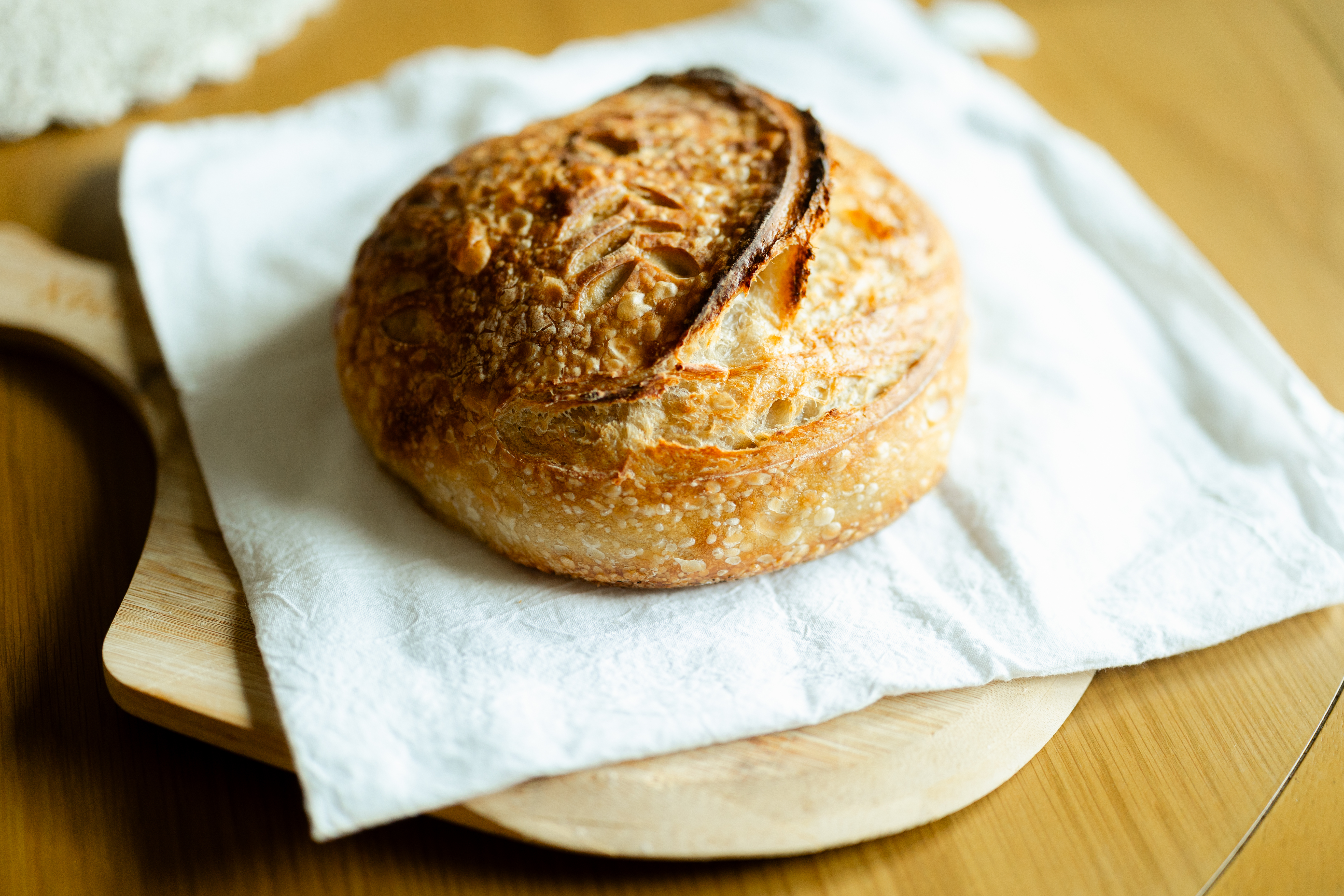
If you go to a grocery store and buy a loaf labeled "sourdough," you're probably not buying sourdough. You're buying bread made with commercial yeast, possibly with vinegar added for tang, baked on an industrial schedule that takes anywhere from two to four hours total. That's not sourdough. That's a lie wearing sourdough's name.
Real sourdough is something different. It's wild yeast and natural bacteria doing the work, slowly, over many hours. It's a process that can't be rushed because the chemistry won't work if you rush it. We ferment our bread for eighteen hours minimum, cold, in a proof box that maintains temperature consistency. That means every loaf we bake takes nearly a full day from mix to oven.
People ask why that time matters, and why bread that takes all that time costs more. The answer is in the fermentation itself.
What commercial "sourdough" really is
Industrial bread production is built on speed. Mix, bulk ferment for a few hours, shape, final proof for an hour or two, bake. That's the timeline that works for factories. Some of those factories add their own strain of "sourdough starter" — a commercial culture, not wild yeast — to their dough. Others add a bit of sourdough culture to an otherwise conventional yeast dough. Some don't even bother and just add vinegar or a souring agent to make the bread taste vaguely tangy.
None of this is real sourdough. Real sourdough is defined by one thing: wild yeast, no commercial yeast, and a long fermentation. That's it. Everything else follows from that.
What happens during eighteen hours
When you mix flour, water, and salt into a bowl, you're not just making dough. You're creating an environment for yeast and bacteria to work. The wild yeast — Saccharomyces cerevisiae — starts eating sugars in the flour and producing carbon dioxide, which makes the bread rise. Lactobacillus bacteria, the same bacteria used in yogurt, start producing lactic and acetic acids that give sourdough its flavor and its slightly tangy character.
But here's what makes eighteen hours different from four hours. Time. During a long, cold fermentation, the yeast works slowly. The bacteria have time to fully develop flavor. The starches in the flour are slowly broken down by enzymes and bacteria, making them simpler and more digestible. The gluten network develops naturally without aggressive mixing or dough conditioners. Every process that should happen in bread is given the time to actually complete.
A four-hour ferment is a race. You're trying to get enough gas production to make the bread rise before the process stalls. A eighteen-hour ferment is patient work. The yeast keeps working. The bacteria keep developing complexity. The flour keeps breaking down. By the end, the dough isn't just risen — it's transformed.
Flavor and digestion
The flavor difference is immediate. A real sourdough loaf has depth. There's a slight tang from the acids, but it's not harsh — it's integrated into the whole flavor profile. You taste complexity because actual chemical transformations have happened in the dough. Commercial sourdough tastes flat in comparison because most of those transformations haven't had time to happen.
The digestion part is less talked about but equally important. People with mild gluten sensitivity sometimes report that they can eat real sourdough when they can't eat conventional bread. The reason is real: long fermentation partially breaks down gluten proteins and pre-digests some of the starches. Your stomach has less work to do. You're not being marketed a healthier product — you're actually eating something chemically different because of how long it fermented.
Our starter and our process
Our sourdough starter has been alive for years. We feed it regularly, maintain it carefully, and it's the wild yeast culture that drives every loaf. When we mix dough, it's flour, water, salt, and starter — four ingredients. Stone-ground flour from a mill in Texas. Nothing else. No commercial yeast, no dough conditioners, no shortcuts.
The dough gets mixed in the morning, bulk ferments for a few hours at room temperature, then gets shaped and moved to our proof box where it ferments cold for twelve to fourteen hours. In the early morning, we shape and score the loaves, and they go into a hot Dutch oven to bake. The result is a loaf with proper crust, open crumb, and flavor that actually reflects the process that created it.
That's why our sourdough is eight dollars a loaf. Not because we're marking it up for mystique. Because eighteen hours of careful fermentation, genuine ingredients, and actual skill takes time and costs money. A two-dollar loaf from the store exists because it was made in four hours with commercial shortcuts. A real loaf can't be made that quickly or that cheaply and still be real.
When you buy sourdough from us, you're buying a loaf that required actual patience. You're eating the result of a process that can't be rushed. That matters. Your taste buds know the difference. Your stomach knows the difference. Time makes bread into something better than bread.