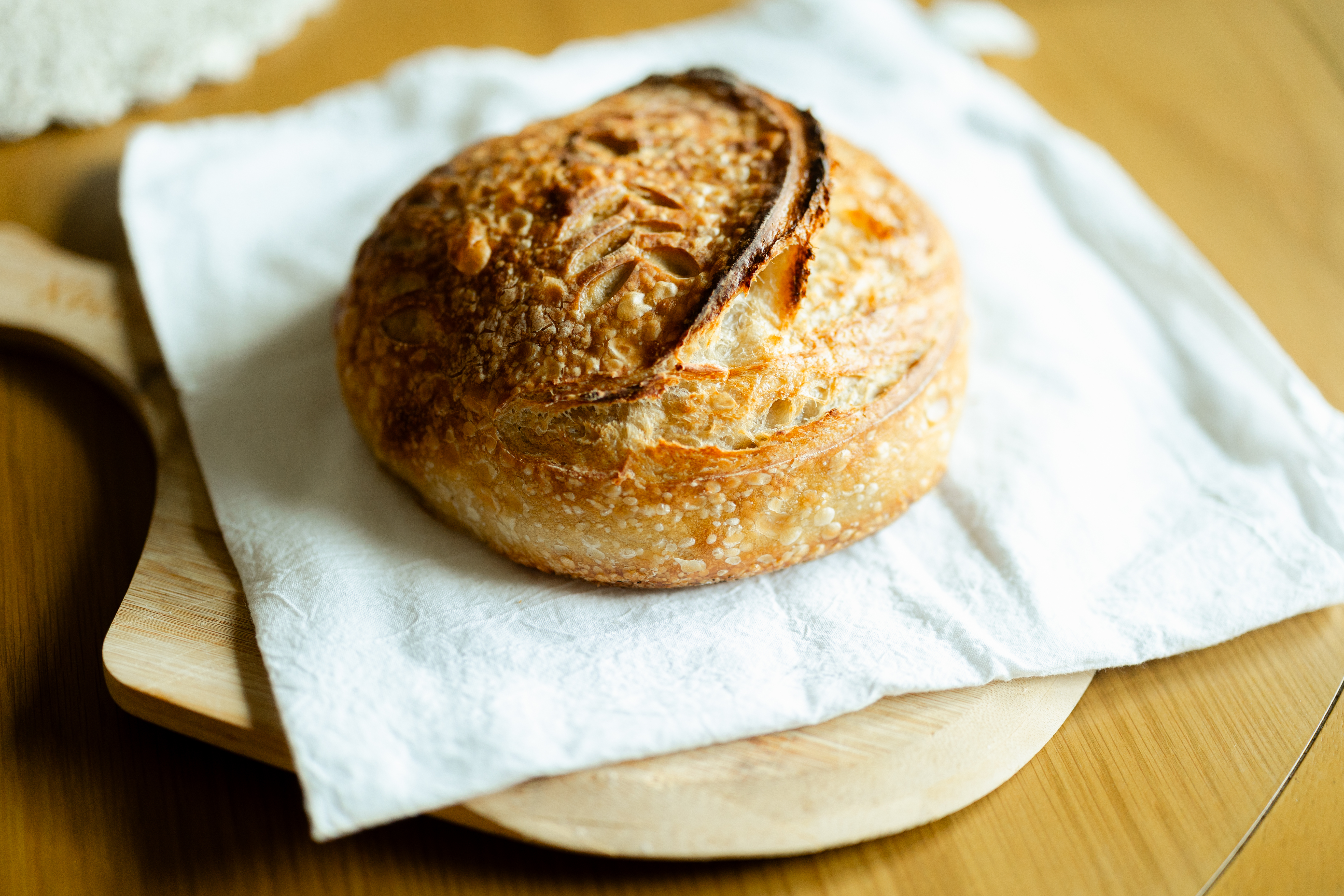
I've been baking sourdough for a few years now, and I still think it's one of the more humbling things you can do in a kitchen. You mix flour, water, salt, and a spoonful of starter, then you basically wait and hope. Some bakes come out incredible. Some come out dense hockey pucks that not even the chickens will eat. We don't talk about those.
But when it works — and it works most of the time now — there's nothing like it. A loaf with a crackly crust, an open crumb that tears into big irregular holes, and that deep sour tang you can't get from a bag at the grocery store. That's what we're baking out here at Honey Bunches of Oaks, and this post is just a quick rundown of how we do it and why we do it this way.
The starter is everything
Sourdough lives or dies by the starter. Ours is a wild yeast culture we've been feeding and maintaining for a few years. We keep it simple: flour and water, fed on a regular schedule, stored in the fridge between bakes. It smells funky in the best possible way — tangy and alive.
The starter is what makes sourdough actually sourdough. It's not commercial yeast. It's billions of wild yeast cells and lactic acid bacteria that ferment the dough naturally, over time. That fermentation is where all the flavor comes from, and it's why you can't rush it.
We let it ferment for 18+ hours
Most of the sourdough you find in a grocery store — even stuff labeled "artisan" — was made with commercial yeast and a splash of vinegar to fake the sour flavor. The whole process takes a few hours. Ours takes at least 18, usually more.
After mixing the dough, we do a bulk ferment at room temperature, with periodic folds to build structure. Then it goes into the fridge overnight for a cold retard — that's where a lot of the flavor develops. We bake it straight from cold in a cast iron dutch oven. The steam trapped inside during the first part of the bake is what gives it that ear — the little ridge along the score — and the blistered crust.
The long ferment isn't just about flavor, either. Extended fermentation allows the wild yeast and bacteria to partially break down the gluten structure and phytic acid in the flour. A lot of people who have trouble with regular bread find long-fermented sourdough sits a lot better with them. That's not a medical claim — just something we've heard repeatedly from our regulars.
We bake to order, not ahead
We don't bake a bunch of loaves and leave them on a shelf. When you order, your loaf gets scheduled into the next bake window and comes out fresh specifically for your pickup. If your timing lines up right, you'll pick it up still warm. That doesn't happen at a grocery store.
We bake in small batches a few times a week depending on orders. The practical reality of that is: most batches sell out before bake day. If you've been meaning to try one, ordering ahead is really the only way to guarantee a loaf.
What we charge and where to pick it up
Loaves are $8 each. Pickup is at the ranch in Dripping Springs. We serve folks coming from Bee Cave, Wimberley, Marble Falls, and all over the Austin area — if you're making a run out to the Hill Country anyway, it's an easy add-on to grab eggs and bread at the same stop.
If you want sourdough for the weekend, get your order in by Thursday at the latest. We'll confirm your pickup window by text and have it ready.
Honestly, just try it
I know there's a lot of sourdough hype out there, and some of it is a bit much. But the difference between real long-fermented sourdough and the stuff most people have eaten is legitimately night and day. The crust, the crumb, the flavor — it's a different food.
We're not trying to be precious about it. We just bake bread the way we think bread should be made: slowly, with good ingredients, without shortcuts. If that sounds like something you want to try, reach out and we'll get a loaf on your next bake day.
Ready to try a loaf? We bake to order a few times a week — get your name on the list and we'll have one ready for your pickup.
Order Your Loaf — $8